
Why Tampa Bay’s Famous Beaches Give Way to Florida’s Wild Gulf Coast
“The complete field guide to understanding one of Florida’s most misunderstood coastlines.”
Table of Contents
Have you ever noticed something strange as you drive north from Clearwater Beach?
The sugar-white sand stretches on for miles.
The Gulf sparkles beside rows of beachfront hotels.
Vacationers fill the shoreline with colorful umbrellas.
Everything looks exactly like the Florida you’ve seen in travel brochures.
Then, somewhere north of Clearwater…
…it changes.
The endless beaches begin to disappear.
The hotels give way to marinas.
Fishing piers replace beach chairs.
Salt marshes stretch toward the horizon.
The Gulf suddenly feels quieter, wilder, and somehow older.
For many visitors, the first reaction is the same:
“What happened to the beaches?”
The answer surprises almost everyone.
Nothing happened to the beaches.
You’ve simply crossed into one of Florida’s most fascinating…and least understood…regions: Nature Coast Florida.
What Is Florida’s Nature Coast?
Florida’s Nature Coast is a stretch of Gulf shoreline where the landscape is shaped less by tourism and more by nature itself.
Instead of miles of wide barrier-island beaches, you’ll find:
- Vast salt marshes
- Coastal estuaries
- Mangrove shorelines
- Working waterfronts
- Fishing villages
- Wildlife refuges
- Natural springs
- Quiet parks
- Kayak trails
- Endless opportunities to experience “Old Florida”
It’s not that this coastline has less to offer.
It simply offers something different.
Understanding that difference changes the way you experience Florida forever.
Florida Doesn’t Have One Gulf Coast
One of the biggest misconceptions about Florida is the idea that every mile of Gulf shoreline should look like Clearwater Beach.
That’s like assuming every mountain town should look like Aspen.
Or every beach town should look like Miami.
Florida’s Gulf Coast is incredibly diverse.
Some areas are dominated by broad barrier islands.
Others by tidal marshes.
Others by freshwater springs.
Others by rocky limestone shelves hidden beneath shallow water.
Each creates a completely different landscape, and eventually, a completely different community.
The coastline shapes the culture just as much as the people do.
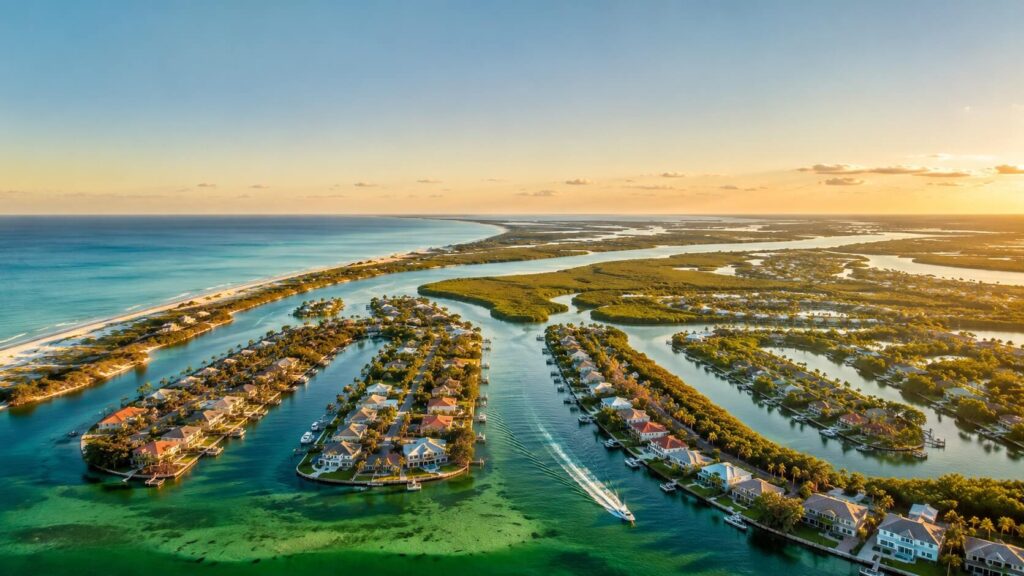
Barrier Islands and Nature Coast Florida
If there’s one concept that explains most of the difference between Clearwater Beach and Florida’s Nature Coast, it’s this:
Barrier islands.
These long, narrow islands sit between the Gulf of Mexico and the mainland.
They’re constantly reshaped by waves, tides, storms, and currents.
Over thousands of years they perform three remarkable jobs.
First, they absorb much of the Gulf’s wave energy.
Second, they trap and accumulate enormous amounts of brilliant white quartz sand carried from ancient Appalachian Mountains by rivers over millions of years.
Third, they create calm, protected bays behind them where seagrass, oysters, dolphins, manatees, and countless bird species thrive.
Without barrier islands, many of Florida’s famous beaches simply wouldn’t exist.
Why Clearwater Looks Like Clearwater
Clearwater Beach isn’t famous because someone decided to build hotels there.
The hotels came because nature had already created one of the finest beaches in North America.
Wide barrier islands.
Constant sand replenishment.
Gentle Gulf waves.
Broad public beaches.
Those natural ingredients eventually attracted visitors, businesses, restaurants, and resorts.
People often think development created the destination.
In reality, the landscape created the opportunity.
Where the Coast Begins to Change
Continue north through Dunedin, Honeymoon Island, Caladesi Island, and Tarpon Springs, and you’ll notice subtle changes.
Barrier islands become narrower.
Natural inlets interrupt the coastline.
Salt marshes become more common.
Protected estuaries expand.
The farther north you travel, the more the landscape shifts from tourism to ecology.
Then you enter Pasco County.
The Communities of Nature Coast Florida
For many visitors, this is where the confusion begins.
The beaches seem smaller.
The coastline becomes quieter.
Instead of rows of beachfront hotels, you’ll discover:
- Marinas
- Boat ramps
- Seafood restaurants
- Fishing communities
- Marshes alive with birds
- Kayak launches
- Waterfront parks
- Working docks
- Quiet coves
- Some of the best sunsets on Florida’s Gulf Coast
Many people mistakenly conclude that the beaches have disappeared.
Locals know they’ve simply entered a different kind of paradise.
Why Nature Coast Florida Looks Different: Wildlife Along Nature Coast Florida
The answer lies beneath the surface.
The Gulf becomes incredibly shallow.
Barrier islands become less continuous.
Tides influence the landscape more than waves.
Fine sediments settle into marshes instead of building wide beaches.
Estuaries expand.
Salt-tolerant plants flourish.
The result is one of the richest coastal ecosystems in the southeastern United States.
That’s why the Nature Coast is famous for fishing, scalloping, birdwatching, paddling, manatee encounters, and wildlife…not massive beachfront resorts.
A Coastline That Never Stops Changing
One of the most fascinating things about Nature Coast Florida is that it isn’t finished.
Barrier islands migrate.
Channels shift.
Sandbars appear and disappear.
Marshes slowly grow.
Storms reshape the shoreline.
Sometimes, a single hurricane permanently redraws the map.
John’s Pass, one of the most famous inlets in the Tampa Bay region, was created during the hurricane of 1848.
Nature continues shaping this coastline today.
While communities do their best to preserve them through Reslient Shoreline Resources
The Coastline Shapes the Communities
The landscape influences far more than scenery.
It shapes history.
It shapes industries.
It shapes lifestyles.
Clearwater became famous for beaches.
Tarpon Springs grew around sponge diving and a protected working harbor.
Hudson became known for boating and fishing.
Weeki Wachee became famous because crystal-clear freshwater springs emerge from underground limestone.
Each community tells the story of the land beneath it.
Which Florida Do You Want to Experience?
This is the question most travel guides never ask.
Do you imagine:
Walking miles of soft white sand?
Launching a kayak into a peaceful estuary?
Fishing before sunrise?
Watching dolphins from a quiet waterfront park?
Exploring islands only reachable by boat?
Photographing roseate spoonbills in coastal marshes?
Relaxing where Florida still feels wild?
There isn’t one perfect version of Florida.
There are many.
Nature Coast Florida simply offers one of the most authentic.
Continue Exploring Nature Coast Florida
If this article changed the way you see Florida’s Gulf Coast, here are a few more field guides to continue exploring:
- Why Do Tampa Bay’s Beaches Suddenly End North of Clearwater?
- What Is a Barrier Island?
- Why Florida’s Sand Is White
- Hudson Beach: What to Expect
- The Best Parks Along Florida’s Nature Coast
- Why the Gulf Is So Shallow Near Pasco County
- John’s Pass: The Hurricane That Changed the Map
- Tarpon Springs: Where Greek Heritage Meets the Gulf


2 Comments